
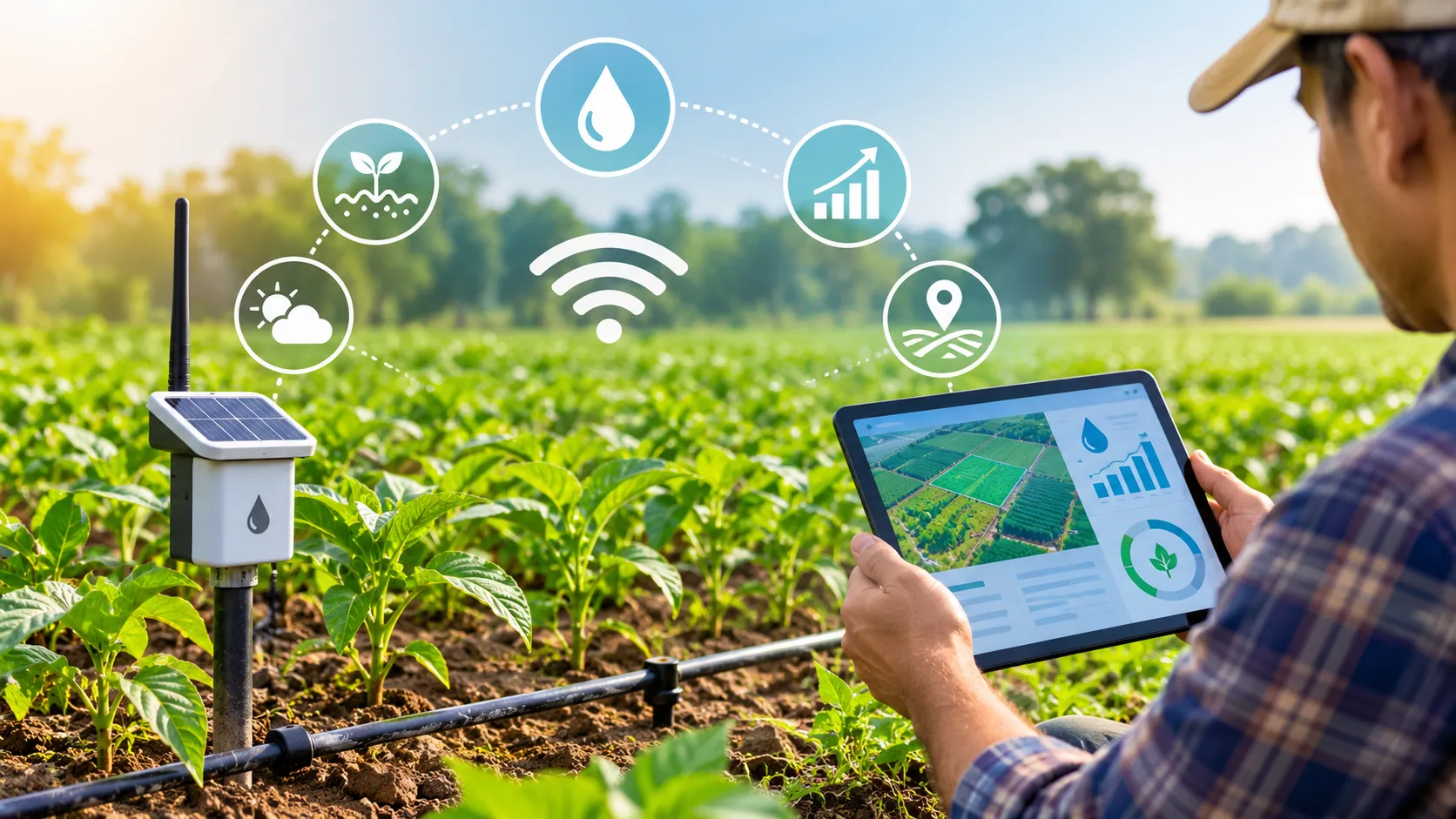
Sustainable irrigation is often presented as a hardware problem: install a smarter controller, replace a nozzle, add a sensor, and water use will fall. Those upgrades can help, but they only work consistently when the people responsible for a site can see what is happening, understand why a decision was made, and adjust their approach over time.
That is a data-management problem.
For turf managers, grounds teams, landscape contractors, growers, and land operators, good records turn irrigation from a repeating calendar task into a responsive operating process. Here are seven practical data practices that make irrigation and land management more sustainable.
The same discipline sits at the heart of farm management software: bringing field activity, input use, equipment work, and operational decisions into one usable record. Although turf and land operations are not farms, the lesson transfers directly. When irrigation, soil observations, maintenance, and input records are disconnected, it is difficult to reduce waste or demonstrate that resource decisions are working.
1. Replace fixed calendars with condition-based irrigation schedules
A fixed schedule is easy to set and easy to forget. It is also one of the fastest ways to irrigate when a site does not need water. Rainfall, temperature, wind, evapotranspiration, plant type, soil conditions, shade, slope, and seasonal growth all change the amount of water a landscape or field requires.
Start by recording the basis for each irrigation decision. That could include recent rainfall, forecast temperature, soil-moisture readings, visual plant stress, or a calculated evapotranspiration estimate. The record does not need to be elaborate. The important point is that a schedule is tied to a condition rather than inherited from last month’s controller settings.
Weather-based irrigation controllers use local weather and landscape information to adjust run times, while soil-moisture-based controllers help prevent irrigation when the root zone already has sufficient moisture. Both approaches are recognised by the US Environmental Protection Agency’s WaterSense programme as alternatives to simple clock-based control systems.
For larger sites, record the date, zone, run time, estimated or measured volume, and reason for the change. Over a season, those entries create a useful baseline: which zones consistently need adjustment, which areas dry out first, and where water use does not match plant performance.
2. Treat soil information as an operating input, not a one-time report
Soil maps and test results are often filed away after planning or installation. That leaves a major source of operational insight unused.
Soil texture, compaction, organic matter, slope, rooting depth, drainage, and water-holding capacity all influence how water moves through a site. A sandy area may need shorter, more frequent applications. A compacted or heavy soil may shed water if too much is applied at once. A shaded section may need substantially less water than an exposed zone even when both appear in the same irrigation block.
Maintain a simple soil-condition record by zone: soil type or known limitations, a recent test date, observations of compaction or runoff, and actions taken. Pooling, recurring dry patches, erosion, or weak turf should become part of the record rather than remain an informal comment.
The USDA Natural Resources Conservation Service treats managed irrigation, soil assessment, and documentation as connected elements of soil-health planning. Its irrigation-management standard also calls for recorded water volumes, scheduling methods, and the data used to determine timing and amount. Its guidance offers a useful model beyond formal conservation programmes.
3. Record inputs by place, time, and purpose
Water is not the only input affected by better data. Fertilizers, soil amendments, pesticides, seed, mulch, and other materials all influence site health and environmental performance. Without a location-specific record, it is hard to tell whether an input was necessary, whether it worked, or whether the same issue keeps returning.
At a minimum, record what was applied, where, when, how much, who applied it, and why. Link applications to the relevant zone, field, bed, course area, or landscape feature. For instance, “fertilizer applied to north practice field” is less useful than a record that identifies the zone, product, rate, weather conditions, and the turf or soil condition that prompted the application.
This makes follow-up more disciplined. If an area repeatedly needs corrective inputs, the manager can investigate an irrigation, drainage, compaction, shade, or equipment problem instead of simply repeating treatment. It also helps prevent accidental duplication when multiple crews or contractors work on the same property.
A complete input history is especially valuable where clients want evidence of reduced chemical use, more efficient nutrient management, organic practices, or lower-impact landscape care. Claims become more credible when they can be supported by a consistent operating record.
4. Monitor irrigation performance, not just controller activity
A controller can run exactly as programmed while the system wastes water. Leaks, broken heads, overspray, incorrect pressure, clogged nozzles, damaged drip lines, and uneven distribution are field-performance problems—not scheduling problems.
Build a routine that combines recorded data with physical inspections. Log meter readings or estimated water use by irrigation area, note system alerts, record repairs, and capture the cause of each issue. Then pair those records with regular site walks. If a zone’s water use rises sharply or performance changes, the team has a starting point for investigation.
The EPA recommends maintaining a dedicated irrigation meter where possible, tracking water-use trends, checking for leaks and misaligned heads, updating schedules for weather and season, and performing periodic system audits. Its commercial irrigation guidance also recommends techniques such as cycle-and-soak watering when slope or soil conditions create runoff risk. EPA WaterSense at Work is clear on a crucial point: efficiency requires ongoing monitoring, not a one-time upgrade.
The operational lesson is simple. Measure the result of irrigation, not only the command sent to the system.
5. Track equipment activity and maintenance alongside land outcomes
Equipment affects sustainability in ways that are easy to miss when maintenance logs are separate from land records. A mower route can contribute to compaction. A malfunctioning spreader can lead to uneven application. A pump issue can disrupt irrigation pressure. Repeated vehicle traffic across wet ground can reduce infiltration and increase runoff.
Log the equipment used, task completed, operating hours where practical, maintenance completed, and the location of recurring issues. That creates a clearer connection between machine activity and site conditions.
For example, poor drainage and weak turf in a high-traffic area may reveal that the same route is used after rainfall. If a zone underperforms after a pump repair, maintenance records can help identify changes in pressure, flow, or controller configuration.
The same records support more efficient scheduling, preventive maintenance, and reduced unnecessary travel.
6. Build a water budget and review it against actual use
A water budget turns a sustainability intention into an operational target. Start with a baseline of bills, meter data, estimated run times, irrigated area, and seasonal demand. Then set an expected range for each major zone or site.
Review actual use monthly and after major weather shifts. If it rises, determine whether weather, a new planting area, a leak, or a controller setting explains the change. The aim is not identical use across every area; it is to make unusual consumption visible early enough to act.
Combined with condition-based scheduling and meter records, a budget helps communicate what changed and why.
7. Keep evidence ready for clients, audits, and continuous improvement
Good data has a second life beyond daily operations. It becomes evidence.
Owners, clients, certification bodies, and internal sustainability teams ask the same questions: What happened, when, why, and did it work?
Keep irrigation schedules, weather or soil rationale, input applications, maintenance actions, inspections, water-use data, and corrective actions in one accessible system. Add photos where they clarify a repair or drainage issue.
Regular review lets teams compare seasons, identify persistent problems, evaluate interventions, and prioritize next year’s budget around evidence rather than assumptions.
What Farm Management Software Can Teach Turf and Land Operations
Farm management software follows a useful principle: record activity where it happens, connect it to a place and time, and use the history to make the next decision better.
Turf and land operations can use the same approach to coordinate people, zones, equipment, inputs, and changing conditions.
A strong system links irrigation schedules to each zone; associates soil and weather observations with watering decisions; retains input and maintenance history; and makes reports easy to retrieve.
Instead of saying, “We normally water this area three times a week,” a manager can say, “We adjusted this zone after rainfall and soil-moisture readings, inspected it for runoff, and reduced run time after correcting a pressure issue.” That is more useful operationally and more credible environmentally.
Sustainability is rarely the result of one device or one policy. It is the accumulated outcome of better daily decisions. Reliable data gives land managers the context to make those decisions, the discipline to repeat what works, and the evidence to show that responsible irrigation is more than a promise.